

A 3-minute microlearning module teaching hospital patients and support persons the importance of proper hand hygiene to prevent infections.
This project addresses a critical need in healthcare settings: ensuring proper hand hygiene among patients and their families to prevent the spread of infections.
This 3-minute module employs accessible language, clear visuals, and interactive elements to effectively convey crucial hand hygiene information, significantly increasing the likelihood of adherence to proper hand washing techniques.

Hospital patients and their support persons, with varying levels of health literacy and diverse backgrounds.
Reduce healthcare-associated infections by increasing knowledge and proper practice of hand hygiene techniques.
3-minute microlearning module designed for quick consumption with maximum retention of crucial information.
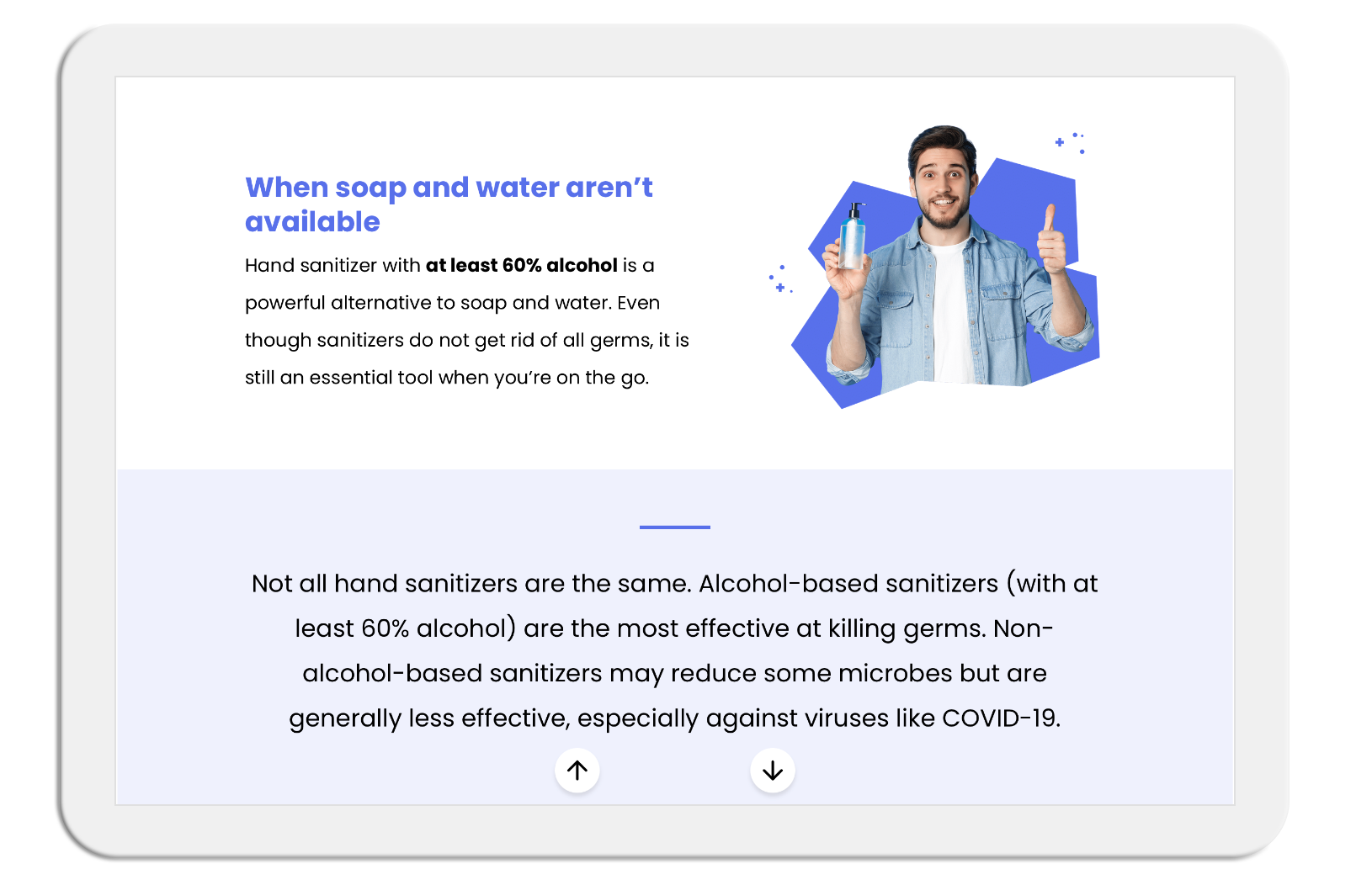
The module utilizes Plain Language principles (6th-grade reading level) to ensure accessibility for individuals with varying levels of health literacy, including clear navigation and culturally sensitive imagery.
Fully responsive design allows seamless access on smartphones, tablets, and desktop devices, enabling learning at the point of need in healthcare settings.
Content is chunked into digestible segments with focused learning objectives, enhancing information retention through spaced repetition and targeted messaging.
Developed simplified content based on WHO and CDC guidelines, focusing on the critical "why, when, and how" of hand hygiene. Created a learning sequence that progresses from motivational messaging to practical instruction. The content was carefully structured to balance thorough coverage of medical guidelines with accessible language for non-medical audiences.
Applied microlearning principles to structure the content into brief, focused segments. Used cognitive load theory to balance informational density with retention. Incorporated interactive elements strategically to reinforce key behaviors. The module was designed to maintain engagement throughout the short learning experience while maximizing knowledge transfer.
Created visual mockups using healthcare-appropriate colors and imagery. Designed a clean, distraction-free interface with emphasis on clarity. Developed visual demonstrations of proper hand washing techniques with animated sequences.
This microlearning module was designed for the Health Standards Organization (HSO) and Accreditation Canada as part of their patient education initiatives. These organizations develop evidence-based health standards and assessments used by healthcare facilities worldwide.
The concept emerged from recognizing that while significant attention is given to staff hygiene protocols, patient education on this topic is often overlooked despite being a crucial component in infection prevention strategies.
This module addresses this gap by providing a focused, accessible educational resource that healthcare facilities can implement as part of their infection prevention programs. The responsive design allows patients to access the material on their personal devices during hospitalization or review it after discharge.
The hand hygiene module demonstrates an excellent understanding of how to present important healthcare information in an accessible way. The approach to simplifying complex medical guidelines without losing their essential meaning shows strong instructional design skills. The module effectively balances educational content with engaging presentation.
This project was designed with specific educational and practical goals in mind, focusing on creating a sustainable resource for healthcare settings:
Enhance understanding of when and how to perform proper hand hygiene in healthcare settings, ensuring patients recognize critical moments when hand cleaning is necessary.
Address common obstacles to proper hand hygiene including knowledge gaps, cultural differences, and accessibility challenges through inclusive design and plain language principles.
Provide healthcare professionals with a ready-to-use educational tool that complements their infection control efforts and reduces the time needed for one-on-one hygiene instruction.
Develop a reusable educational asset that can be implemented across different healthcare settings and integrated into existing patient education programs with minimal adaptation required.